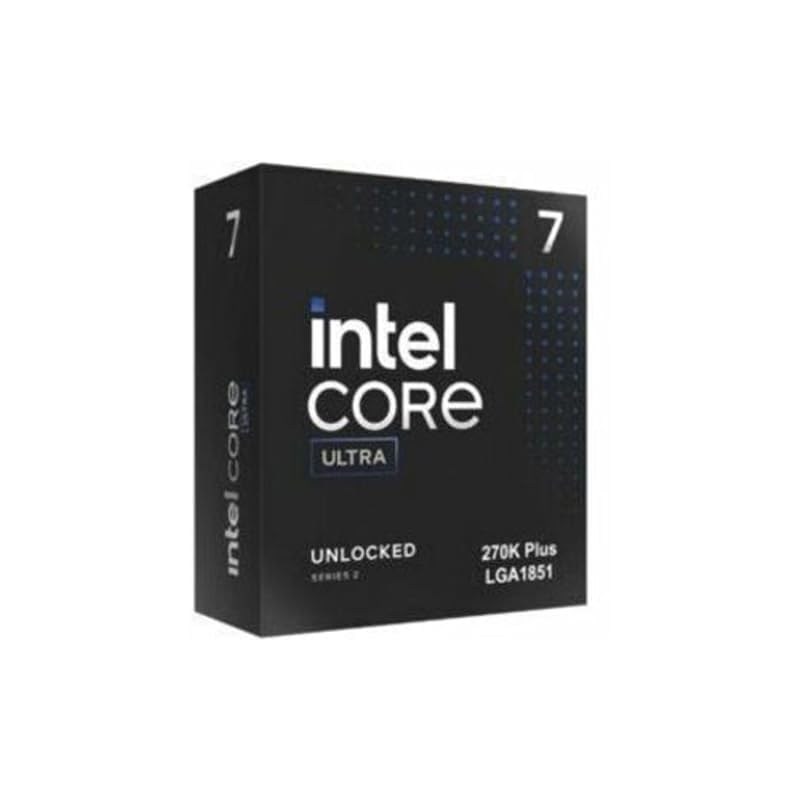


The 270K Plus is what the original Arrow Lake 200-series should have been at launch. Same socket, same architecture, same chipset compatibility, but with higher boost clocks, native DDR5-7200, Intel Binary Optimization, and the firmware fixes that should have shipped 18 months ago. It beats the 265K by a meaningful margin in mixed workloads. The harder question is "is it faster than the Ryzen 7 9800X3D?" The short answer: not in games, but maybe in everything else, and at $299 vs $479 the value math gets interesting fast.
Intel Core Ultra 7 270K Plus
24 cores (8 P + 16 E) · 5.5 GHz boost · 36 MB L3 · LGA1851 · 125 W base / 250 W turbo · $299
The 270K Plus is the headline pick for Intel's refreshed lineup. It keeps the original 200-series socket, and Intel fixed the launch issues and added enough productivity throughput at the $299 price point to be a serious alternative to the Ryzen 7 9800X3D for buyers who do anything beyond pure gaming.
- 24 cores at $299 is a productivity bargain
- Native DDR5-7200 closes the memory-bandwidth gap
- LGA1851 platform is stable now that microcode is patched
- Still loses to the 9800X3D in pure-gaming benchmarks
- Higher idle and load power than AMD competitors
- Arc Xe-LPG iGPU (64 EU) is fine for diagnostics but not for gaming
Tom's Hardware rates it Intel's fastest gaming chip; that doesn't make it the fastest gaming chip overall (the 9800X3D still wins games where the X3D cache helps), but for mixed gaming + creator workloads it's the cleanest choice in this price tier. The 250 W max turbo power unlocks the productivity case: sustained Cinebench R23 puts the 24-core configuration well ahead of the 8-core 9800X3D in any thread-scaled benchmark.
Intel Core Ultra 5 250K Plus
18 cores (6 P + 12 E) · 5.3 GHz boost · 30 MB L3 · LGA1851 · 125 W base / 159 W turbo · $199
Tom's Hardware called this "the new best $200 CPU"; GamersNexus' summary was that the chip "matches the competition in gaming and absolutely runs circles around other chips in applications." 18 cores at $199 is a productivity floor that the Ryzen 5 7600 (6 cores at the same price) can't approach.
- Top productivity at the $200 mark
- Same DDR5-7200 platform support as the 270K Plus
- Phoronix's Linux review highlighted standout code-compile and scientific value
- Pure-gaming buyers still get more from a Ryzen 5 7600 ($180) or 7800X3D
- Lower turbo power (159 W) caps sustained throughput vs the 270K Plus
AMD wins this price bracket on gaming: the Ryzen 7 7800X3D at about $329 still beats both for pure FPS-bound titles. The 250K Plus is the new default productivity recommendation for buyers who need 18 cores of compute over 8 cores of cache.
The numbers.
| 270K Plus | 250K Plus | 9800X3D (ref.) | |
|---|---|---|---|
| Cores / threads | 24 (8 P + 16 E) / 24 | 18 (6 P + 12 E) / 18 | 8 / 16 |
| P-core boost | 5.5 GHz | 5.3 GHz | 5.2 GHz |
| L3 cache | 36 MB | 30 MB | 96 MB (3D V-Cache) |
| TDP base / turbo | 125 / 250 W | 125 / 159 W | 120 W |
| Memory | DDR5-7200 | DDR5-7200 | DDR5-5600 (6000 OC) |
| Socket | LGA1851 | LGA1851 | AM5 |
| iGPU | Arc Xe-LPG 64 EU | Arc Xe-LPG 64 EU | Radeon 2-CU |
| MSRP | $299 | $199 | $479 |
| Strength | Mixed gaming + creator | Best $200 productivity | Pure gaming king |
Other strong options.
Intel Core Ultra 9 285K
Intel cancelled the planned 290K Plus, so the original 285K stays at the top of the stack: 24 cores like the 270K Plus with a 5.7 GHz boost. For most buyers it's a poor value vs the 270K Plus; for buyers who need maximum single-thread performance for 1% lows in CPU-bound games or top-end productivity, it's the option.
AMD Ryzen 7 7800X3D
The 7800X3D runs a step behind the 9800X3D in games at $150 less. The smart-money pure-gaming pick if you can find one at street price. AM5 socket means a 9800X3D drop-in upgrade later if you want it.
AMD Ryzen 9 9950X
The 9950X is the productivity-first AMD answer to the 270K Plus: 16 cores, no X3D cache, ~$549. It wins pure thread-scaled benchmarks at a higher price than the Intel chip.
The buying guide.
Buy the 270K Plus if
You game and also do significant productivity (content creation, code, Blender, streaming). You want the best Intel chip available without paying Core Ultra 9 285K money. You're committed to LGA1851, already own a Z890/B860 board, or want Intel's platform features like USB4 + Thunderbolt.
Buy the 250K Plus if
You want the best productivity-per-dollar at $200. You do code compile, scientific computing, or Linux workloads (where 18 cores shines). Pure gaming isn't the priority but you want decent gaming performance as a bonus.
Don't buy either if
You game and only game: the 9800X3D is still the right answer at any price. You already own a Core Ultra 200-series chip, the upgrade gain isn't worth the cost. You're invested in AM5, switching platforms means new motherboard + RAM, killing the chip-vs-chip price comparison.
Platform requirements
Both Plus chips require an LGA1851 motherboard with Intel 800-series chipset, Z890, B860, or H810. LGA1700 boards (Z790, B760, H770) do not work; the socket changed with the 200-series. Most LGA1851 boards from late 2024 onward are compatible after a BIOS update.
FAQ.
Yes, with a BIOS update. Every Z890 / B860 / H810 board released since late 2024 supports the Plus refresh after flashing to current firmware. Most retail boards in 2026 ship with current BIOS; if yours doesn't, the BIOS Flashback feature on most Z890 boards lets you update without a CPU installed.
It's a real thing, a firmware-level instruction-scheduling tweak, but the gains are modest: typically 2-5% in supported workloads. It's a refinement, and the original 200-series can't access it.
Yes-ish. 250 W max turbo power means a 240 mm AIO minimum; a 360 mm AIO or flagship dual-tower air cooler (NH-D15 G2 class) for sustained workloads. Compared to the 9800X3D's 120 W TDP, the 270K Plus needs roughly twice the cooling capacity to extract its full potential.
No. LGA1851 / Intel 800-series chipsets are DDR5-only. There is no DDR4 path on this platform.
For most buyers, yes: the Plus's microcode and IBO improvements close most of the gap with the 285K, and the 270K Plus costs much less. The Core Ultra 9 285K still wins peak single-thread benchmarks, but the value proposition of the 270K Plus is much stronger.
For Intel buyers: the 270K Plus.
For pure gaming: the 9800X3D still wins.
For best $200 CPU: the 250K Plus.
The Plus refresh is what the 200-series should have been at launch. It is more capable than the chips it replaces, runs on a stable platform, and adds native DDR5-7200 support that closes the memory-bandwidth gap. Intel needed a clean launch after the 200-series, and the Plus refresh is one.